- Two applicants in the same Match can link their rank lists as a couple.
- You rank pairs of programs, one for each partner, in order.
- Include pairs where one partner is unmatched, if you'd accept that, to raise your odds.
- Both partners must be in the Main Match. It doesn't work if one is in an early Match.
Matching as a couple is a beautiful decision: you're choosing your career and your life together. It takes more planning, but it absolutely works.
How it works
Each partner registers for the Match and joins as a couple in R3. Instead of two separate lists, you build one list of pairs: "Partner A at Program X, Partner B at Program Y." The algorithm works through your pairs in order and matches you to the first pair where both of you can be placed.
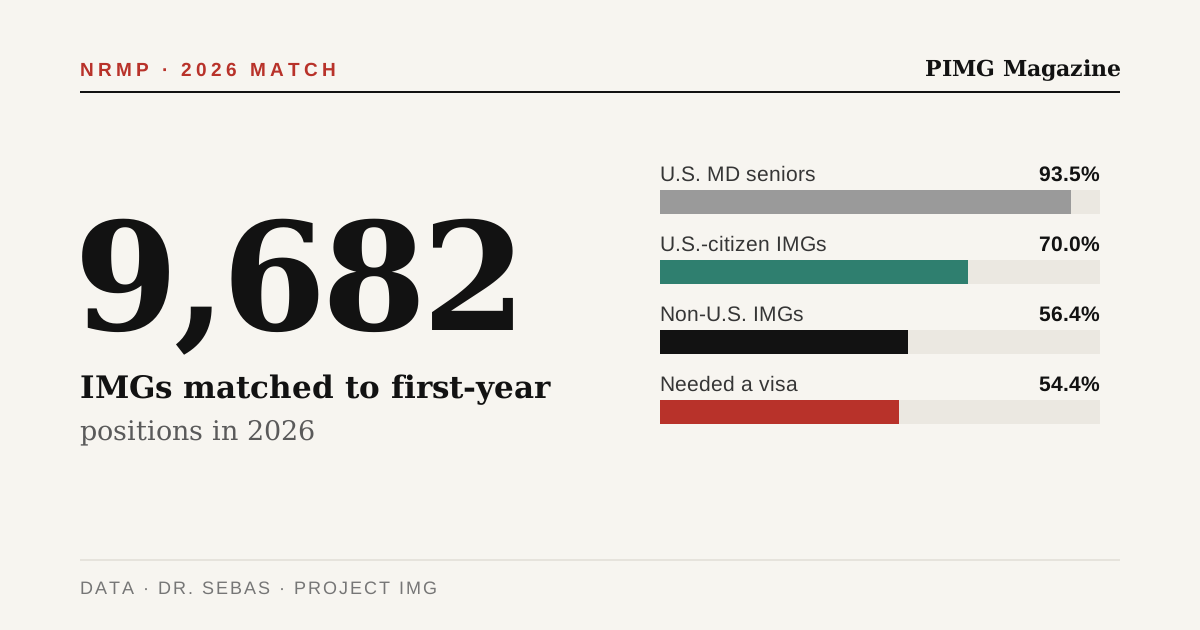
Who matched in 2026: PGY-1 match rate by applicant group
Same algorithm, very different odds. The visa is now the biggest gap for non-U.S. IMGs.
Building paired lists
- Each partner lists the programs they'd accept.
- Group programs by city or region.
- Make every reasonable combination in the same area, starting with your favorites.
- Decide together whether to add pairs where one of you goes unmatched ("no match" for one partner), and where to put them.
| Rank | Partner A | Partner B |
|---|---|---|
| 1 | Program X (City 1) | Program Y (City 1) |
| 2 | Program X (City 1) | Program Z (City 1) |
| 3 | Program W (City 2) | Program V (City 2) |
| … | … | … |
| Late | Program X (City 1) | No match |
Couples need longer lists. More good combinations mean more ways for both of you to land together.
For IMG couples
- Check visa sponsorship for both partners in every pair.
- If one partner has a stronger application, apply widely in cities where the other is competitive.
- Talk early about plan B, including whether one partner would do a preliminary year or research while the other trains.
Before you certify
- Both partners joined as a couple in R3
- Every pair is in an order you both agree with
- Pairs with "no match" are placed where you both want them
- Both of you certified by March 3, 2027, 9 p.m. ET
How the algorithm treats a couple
For a couple, a "match" only counts when both partners can be placed in the same pair on your list. The algorithm goes down your paired list in order. If Partner A could match at a program but Partner B can't be placed in that pair, the algorithm moves to the next pair. That's why the order and the number of pairs matter so much.
Four couple scenarios
| Situation | Strategy |
|---|---|
| Same specialty, same strength | Apply to cities with several programs in your specialty, so many combinations exist. |
| Different specialties | List cities where both specialties have programs that take IMGs. Big cities and university hospitals with many departments help. |
| One stronger, one weaker applicant | Build the list around where the weaker applicant is competitive, then pair the stronger applicant's options there. |
| One partner needs a visa, the other doesn't | Filter every pair by the visa partner's sponsorship first. |
If only one of you matches
Decide this before ranking, not on Match Day. Options many couples consider: the unmatched partner does SOAP, a research year or USCE in the same city, or applies again next year. Think about the visa too: the spouse of a J-1 resident can come as a J-2 and may apply for work authorization, while the spouse of an H-1B resident (H-4) usually has more limited work options. Ask an immigration attorney about your case.
Talk about these before you rank
- Is being in the same city a must, or is a nearby city acceptable?
- Would one of you take a preliminary year so you can be together?
- How do you feel about long distance for one year?
- Whose career gets priority this cycle, and is that fair to both of you?
Practical tips for the paired list
- Use a spreadsheet: one column per partner, one row per pair, a column for city and one for visa.
- Start with your dream pairs, then all reasonable combinations in each city, then "no match" pairs for one partner if you'd accept that.
- Interview at as many programs as possible in shared cities. Each extra interview multiplies your combinations.
- Tell programs you're couples matching, if you're comfortable. Some programs coordinate with other departments.
Your step-by-step plan
- Talk about priorities: same city, same hospital, or same region?
- Apply widely in the same cities, especially where the stronger applicant is competitive.
- Coordinate interviews so you can compare programs together.
- Both join as a couple in R3.
- Build your paired list in two sessions on different days.
- Both certify before the deadline.
Common mistakes to avoid
- Building a short paired list.
- Forgetting visa sponsorship for one partner.
- One partner certifying without the other agreeing.
- Not discussing a plan B.
💡 Dr. Sebas’s tip
Make your paired list in two separate sessions on two different days. The second time, you'll notice combinations you missed when you were tired.
Frequently asked questions
Does couples matching lower our chances?
It adds constraints, so longer paired lists help a lot.
Can we be in different specialties?
Yes. Many couples are in different specialties.
Is there an extra fee?
Couples registration has its own fee rules. Check the current NRMP fees.