- Rank programs in the order you want them, not where you think you'll match.
- Ranking a "reach" program first never costs you a safer one lower down.
- Include every program you'd truly attend. Leave out the ones you wouldn't.
- Certify by March 3, 2027, 9 p.m. ET.
The rank list is the one part of the Match that is completely in your hands. And the best strategy is also the simplest one: be honest with yourself.
Every year, IMGs hurt their own chances by trying to outsmart the Match. They move a "safer" program to the top, or leave off one they liked because "they won't rank me anyway." The algorithm doesn't reward either move.
What "applicant-proposing" means
The algorithm starts with your list. It tries to place you in your #1 program. If that program has ranked enough applicants above you to fill its spots, it moves to your #2, and so on, until it finds a program that ranked you high enough or your list runs out. Because it begins with your preferences, putting a dream program first never costs you a program further down your list.
Rank in the order you want, not in the order you think you'll get.
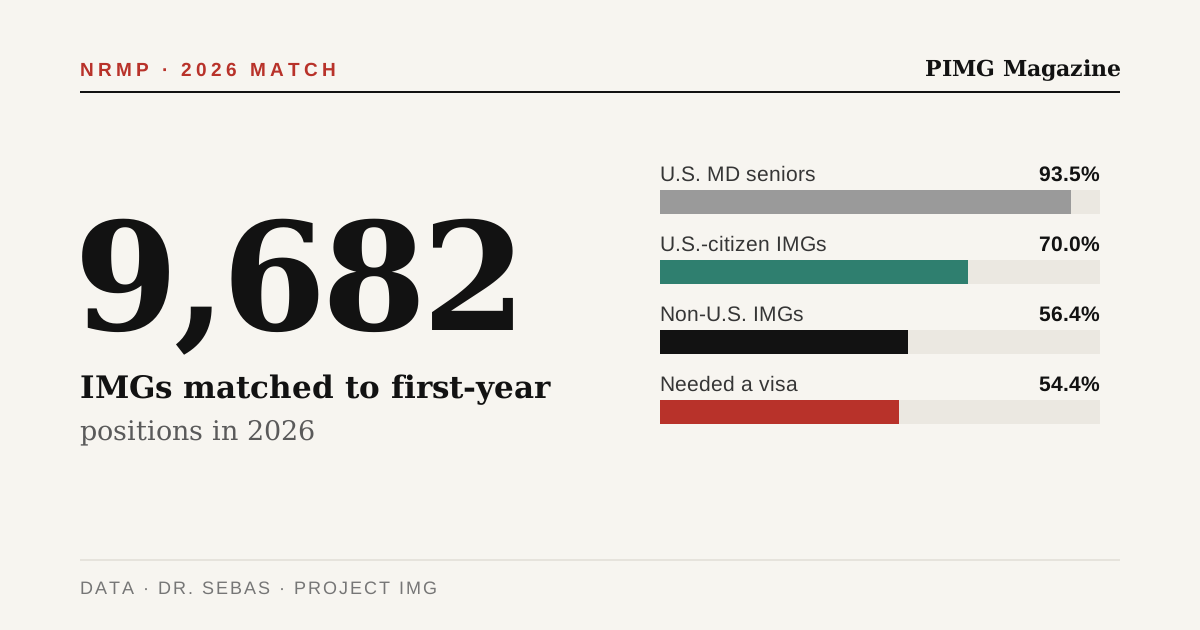
Who matched in 2026: PGY-1 match rate by applicant group
Same algorithm, very different odds. The visa is now the biggest gap for non-U.S. IMGs.
Five rules that work
- True preference order. Ask yourself: if I could pick any of these tomorrow, which one first?
- Rank everyone you'd attend. A longer list raises your chance of matching. For IMGs, every interview is valuable, so don't drop a program over a small worry.
- Never rank a program you wouldn't attend. Matching there is binding.
- Visa reality check. If you need sponsorship, confirm that each program sponsors your visa type before you rank it.
- Think about preliminary positions. If you're applying to a specialty that starts at PGY-2, build a supplemental list of prelim or transitional programs.
✅ Good reasons to rank lower
- You felt the residents were unhappy
- The program can't sponsor your visa
- Poor fit for your family or long-term goals
❌ Bad reasons to rank lower
- "They probably ranked me low"
- A program sent you a nice email
- Your friend thinks it's better
Use R3 the smart way
Ranking opens February 1 at noon ET. Enter a draft list and certify it right away. You can change and re-certify it as many times as you want until March 3, but only a certified list goes into the Match. The NRMP will never add, delete or move programs for you.
Before you certify
- Is every program spelled and tracked correctly (categorical vs. preliminary vs. advanced)?
- Did you add your supplemental list, if you need one?
- Did you leave off anything you'd regret matching to?
- Did you take a screenshot of the confirmation?
Your step-by-step plan
- Right after each interview, write three things you liked and three worries.
- In January, sort programs into "would love," "would be happy," "would accept."
- Remove any program you would truly not attend.
- Check visa sponsorship for every program left.
- Enter your list in R3 and certify it right away.
- Sleep on it, adjust if needed, and re-certify.
Common mistakes to avoid
- Ranking where you think you'll match instead of where you want to go.
- Leaving off programs you'd accept because "they won't rank me."
- Forgetting a supplemental list for advanced positions.
- Not certifying.
💡 Dr. Sebas’s tip
Before ranking, imagine opening your Match email and seeing each program's name. Notice your first feeling, joy or disappointment. That feeling is your real order. Trust it.
Frequently asked questions
Does ranking more programs hurt me?
No. A longer list of programs you'd truly attend increases your chance of matching.
Should I rank a program that didn't seem interested in me?
Yes, if you'd be happy there. You never know how a program ranked you.
Can programs see my rank list?
No. Your list is confidential.